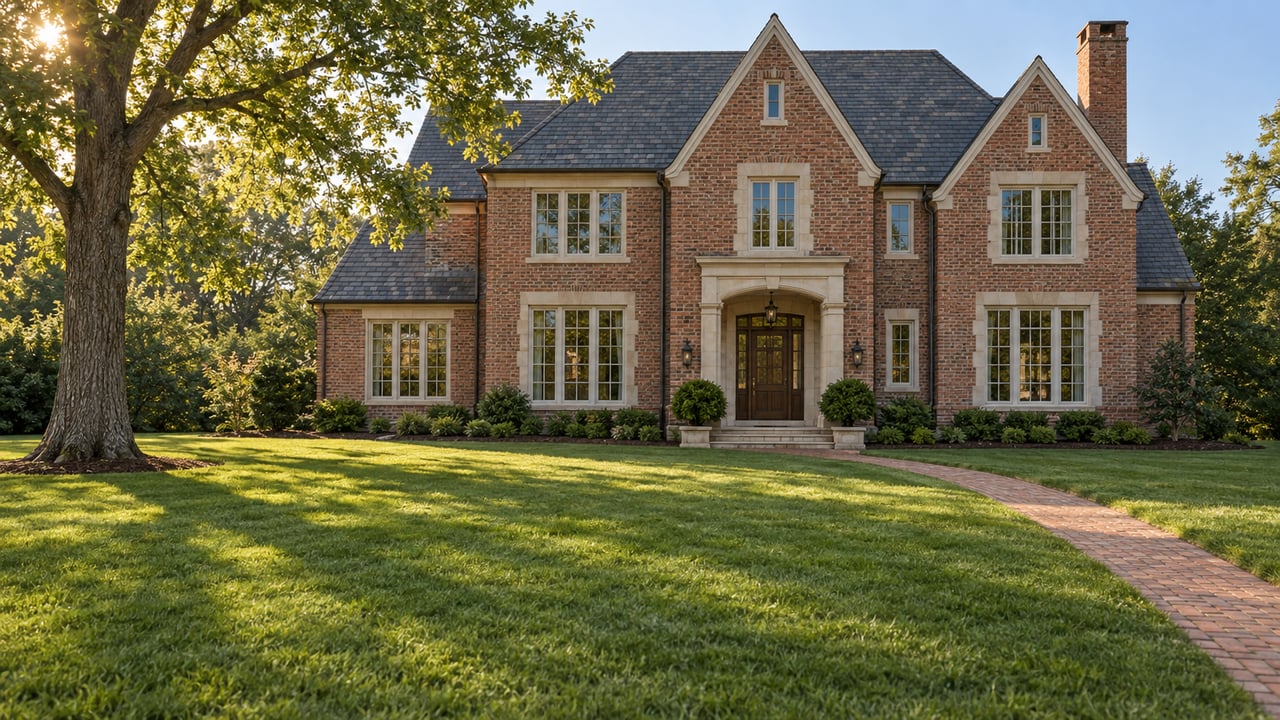
Two listings can carry the word "Piedmont" in the address line and describe two completely different ownership experiences. One is a golf-course colonial on a quarter-acre behind the main gate, connected to public water and sewer like every other house on the street. The other sits on ten acres off Old Carolina Road, behind its own separate gate, with a well supplying the taps and a septic field handling everything that goes down the drain. Both show up under the same community name on a home search. Only one of them comes with a state permit file.
That second listing belongs to the Piedmont Riding Club, the equestrian section tucked inside the broader Piedmont community alongside the main gated golf neighborhood and Old Carolina Estates. The three sections share a name, a golf club, and an athletic center. Their utility arrangements differ, and that distinction reshapes the due-diligence list, the monthly carrying cost, and the pool of future buyers in ways a median list price never shows.
A Second Gate for a Reason
Piedmont's own homeowner association materials describe the community as roughly 1,619 homes split across Old Carolina Estates, the main gated golf section, and the Piedmont Riding Club. The Riding Club has always operated behind its own gate, separate from the entrance guards serving the golf-course streets. That is not a cosmetic detail. It signals a section built around a different lot type from the start: ten-acre parcels designed for horses, not quarter-acre lots designed for proximity to a clubhouse.
The Riding Club's monthly association dues have historically run higher than the golf-course single-family rate. Any current buyer should confirm the exact figure directly with the Piedmont Owners Association before budgeting it into an offer, since dues schedules change year to year and the most reliable number is whatever appears in that year's resale disclosure packet, not a figure pulled from an old rate sheet.
Public Water and Private Systems Across Piedmont
The golf-course section and Old Carolina Estates sit on public water and sewer, the same utility backbone that serves most of suburban Haymarket. Riding Club utility arrangements can vary by parcel, though many ten-acre estates rely on private wells and septic systems. For those properties, the system type changes who regulates it and who pays for its upkeep.
For Riding Club parcels with onsite sewage systems, Virginia does not leave septic oversight to Prince William County's building department. The Commonwealth centralizes onsite sewage regulation under the Virginia Department of Health, governed statewide by regulation 12VAC5-610. New systems, repairs, and upgrades for those parcels run through VDH's local health district office rather than the county permit counter a buyer might expect from a typical suburban purchase.
The fee schedule for those systems reflects that separation. According to Septic & Well, a new construction permit currently runs around $425 to cover VDH's review of the site evaluation, a visit to confirm the work, and a final inspection. A repair permit for a failing system drops to $250, and a voluntary upgrade to a working system runs $300. Ongoing maintenance follows its own calendar: according to SepticPath, a conventional gravity system typically needs pumping every three to five years, while an alternative treatment unit, the kind more common on larger or more complex lots, requires a licensed operator's visit every three, six, or twelve months. An annual monitoring fee generally lands between $125 and $200.
For a Riding Club property with a private system, none of that is disqualifying. It is simply a cost and a compliance rhythm that a golf-course buyer down the street never has to think about, because their water bill and their sewer bill are the whole story.
What Ten Acres Buys That a Quarter-Acre Can't
The trade for that added complexity is real. Riding Club listings describe genuine horse country: private trails for walking, cycling, and horseback riding woven through the estates, with room on many parcels for a custom barn or an accessory structure. One recent listing for a private ten-acre Riding Club estate noted a septic and well system with clean reports and included a Rhino ATV with a plow for clearing the driveway, a detail that says as much about the maintenance rhythm of ten acres as any spec sheet could.
The estates also sit closer to Haymarket's larger public green spaces than the description of "gated golf community" usually suggests. Conway Robinson State Forest offers trails for hiking and biking a short drive away, and James S. Long Regional Park adds picnic areas and open fields nearby. A golf-section buyer gets the clubhouse and the Tom Fazio-designed course built in 2001. A Riding Club buyer gets that plus land that behaves more like a small rural property than a suburban lot, with the acreage flexibility to match.
The Comparison That Actually Matters
| Gated Golf & Old Carolina Estates | Piedmont Riding Club | |
|---|---|---|
| Typical lot size | Quarter-acre to half-acre | Around 10 acres |
| Water and sewer | Public utilities | Typically private well and septic |
| Permitting authority | Standard county process | For onsite sewage: Virginia Dept. of Health, 12VAC5-610 |
| Gate access | Main community gate | Separate dedicated gate |
The list price on a portal search treats all three sections as one neighborhood. The utility line, the permitting authority, and the land-use rules treat them as three different kinds of ownership.
What to Verify Before You Write an Offer
A buyer moving from a public-utility townhouse into a Riding Club estate is taking on a different set of questions than the ones that matter in the golf section. Before signing anything, confirm:
- Whether the system is conventional or an alternative treatment unit, since that decides whether you're looking at a pump-out every few years or a paid monitoring contract every year.
- The date of the last pump-out or service visit, and whether the seller can produce the operation and maintenance manual VDH expects to stay with the system.
- The well's flow rate and any water quality testing on file, since a low-yield well on ten acres is a different problem than a low-yield well on a quarter-acre with municipal backup.
- The current Riding Club association dues and gate access terms, confirmed directly with the Piedmont Owners Association rather than assumed from the golf-section rate.
- Whether the CC&Rs governing your specific lot address horse-keeping, barn construction, or accessory structures, since land-use rules can vary even within the Riding Club depending on when a given section was platted.
That list does not appear in a standard buyer's checklist for Northern Virginia, because most Northern Virginia neighborhoods do not ask a buyer to think about a state health department at all.
A Short FAQ
Do all Piedmont Riding Club homes run on well and septic? The Riding Club listings we reviewed describe private well and septic systems, but utility type can vary parcel by parcel in any acreage community. Confirm the specific system for the exact lot you're considering before you write an offer.
Is the higher Riding Club HOA fee just for the second gate? The available information does not establish whether the higher fee is just for the second gate. The exact current figure and what it covers should come from the Piedmont Owners Association or the resale disclosure packet for the specific home, not from a rate sheet published in a prior year.
Can a golf-section buyer keep horses if they really want them? Land use is governed by each section's specific CC&Rs. The acreage and infrastructure that support horse-keeping in the Riding Club are not typically present on the smaller golf-section lots, so this is a question to raise with the association directly rather than assume either way.
If you're comparing a golf-course listing against a Riding Club estate and want someone who can read the CC&Rs, the septic file, and the gate agreement side by side before you write a number, Washington Street Realty is a short drive from both gates. Schedule a consultation and bring the addresses.
This article is general information, not legal, tax or financial advice. Consult a qualified professional about your situation.